
Annual Profections: Divine Timing with Ancient Astrology

Image by Christian Totty, 2017.
Observing Shadow and Light
One of our responsibilities as humans is to witness the Universe as it unfolds and changes, both within us and around us. We observe the setting and rising of the Sun, and the changing shape of the Moon from one phase to the next. In the magic dance between shadow and light, early astronomers discerned the workings of the heavens, tracing stars that shift relative to those that are fixed. Through the passage of time, and the exchange between day and night, great stories of creation have been spun. The sky has always been a site for meaning-making.
If you’ve had a birth chart reading, you’re likely familiar with the powerful insight that astrology can provide. There is a world of information contained in the significations of the signs, planets, and houses, and the relationship between them is an important part of understanding how they work together to tell the unique story of your life.
Astrologers will often apply particular delineation methods to help their clients gain a deeper understanding about themselves, their past and present circumstances, and what may likely unfold in the future. These techniques originate in ancient Egyptian, Babylonian, and Greek astrology, and, until recently, were relatively unknown in the astrological community. As ancient texts are translated into English, as well as other languages, more techniques are being recovered. In this article, I’ll outline the use of a particular technique known as Annual Profections, and provide a chart example to help illustrate its use.
Timing Your Life according to Ancient Astrology
When our ancestors began experimenting with ways of keeping time, their connection to the celestial realm was direct and intimate. There were no clocks to count the hours, or technology that tracked the movement of planets. By bearing witness to the changing sky, they were able to trace the passage of time.
Time-Lord techniques come from what are called Time-Lord systems in ancient Hellenistic astrology. In the Greek language, the term time-lord is a translation of the word “chronocrator,” a composite of chronos, meaning time and krator, meaning ruler. Time-Lord systems are similar to the Dasha systems belonging to Jyotish, or Vedic astrology, where planetary periods become more active at particular points in time. During these active periods, the conditions of each planet are said to “ripen” or dictate the timing of life events.
The 2nd century Hellenistic astrologer Vettius Valens, one of the primary scholars on this subject, recorded many of the theoretical, philosophical, and technical instructions on astrology in his seminal, multi-volume text TheAnthology. Much of Valens’ work was developed in and around Alexandria, Egypt, where other well-known astrologers lived and studied at the time, including Dorotheus of Sidon and Claudius Ptolemy.
One of the essential components in timing techniques is the observation of planetary motion, based on the principles of astronomy. Celestial bodies move at varying speeds according to their density, size, atmosphere, and distance from the Sun. From our vantage point, stars always rise in the east, culminate in the meridian, and descend in the west. This clear and evident path, in which the sky appears to make a revolution in a 24 hour period, is called primary or diurnal motion and occurs due to the Earth’s rotation.
Planetary motion is cyclical, and can be traced through secondary motion. Within this motion there are two major periods: a zodiacal cycle, also referred to as sidereal cycle, and a synodic cycle. In observing the motion of the planets, astrologers can witness patterns emerge over time. A helpful example to help concretize how planetary cycles unfold is to look at recurrence transits, or aspects, when a planetary alignment in a chart repeats in the sky (i.e. a Saturn-Neptune conjunction). I think it’s important to mention this first because it provides a framework for understanding how Time Lord techniques were originally developed.
How to Apply Annual Profections
One of the foundational concepts in astrology is that a chart is essentially a map of the sky. According to the specific day, time, and location of a birth or event, you can know the specific coordinates that begin the life of a person, or the inception of an endeavor (i.e. like planning a trip, or launching a new business). While the coordinates of your natal chart remain consistent, your chart is fundamentally dynamic and alive. The landscape of your life can look different from one year to the next, and that is why a technique like Annual Profections is so powerful.
Annual Profections is a predictive timing technique rooted in ancient Hellenistic astrology. It essentially links each year of life to one astrological house, thereby assigning a zodiac sign and ruling planet, or Time-Lord, every 12 months. According to astrologer Chris Brennan, Annual Profections is the most widely used of the ancient timing techniques. He notes that, although there was no technical name for it in the Hellenistic tradition, it was likely referenced as a method for determining the Lord of the Year, or the planet that is ruling the year based on which house and sign is profected. Although the term is no longer in use, according to Merriam-Webster's Dictionary, it comes from the Latin term profectus denoting progress, growth, increase, or advancement.
In practice, you can determine which profection year you are in through a step-by-step process. First, you’ll want to have your birth chart for reference. Then, I recommend reviewing each of the age and house associations. Note that the First House starts at age 0, and each year advances around the wheel all the way to the Twelfth House. When you reach age 12 you will return to a First House profection year, and from there the cycle continues.

How each age and House correspond in Annual Projections.
Chart Example: Amanda Gorman, National Youth Poet Laureate
At one point in time, astronomy and astrology were one discipline meaning there was no separation between the science and art of cosmic study. It was not uncommon for early astrologers, such as Marcus Manilius, to utilize the poetic form as a way to recall and delineate astrological wisdom. Poets who create works about cosmology and metaphysics are also with us in the present. Think: Sun Ra, Tracy K. Smith, and Rumi. In Africa, this was the essential role of the Griot. They were not only skilled orators, but historians, genealogists, alchemists, mathematicians, and medicine people. It is for this reason why poetry and the oral tradition remain cornerstones in our shared history, shaping philosophical, social, and political development across generations.
One such contemporary poet, who exemplifies the power of the spoken word, is Amanda Gorman, who became the first National Youth Poet Laureate in 2017. Gorman is well known for the stirring poem she delivered at the inauguration of Joe Biden on January 20, 2021. “The Hill We Climb” became a beacon of lyrical light amid the tumultuousness of the pandemic. Gorman was 22 years old when she was an honored guest at the White House, just weeks after the insurrection on the Capitol. Her moment on the Hill was forged by a lifetime of dedication to the love and craft of poetry.
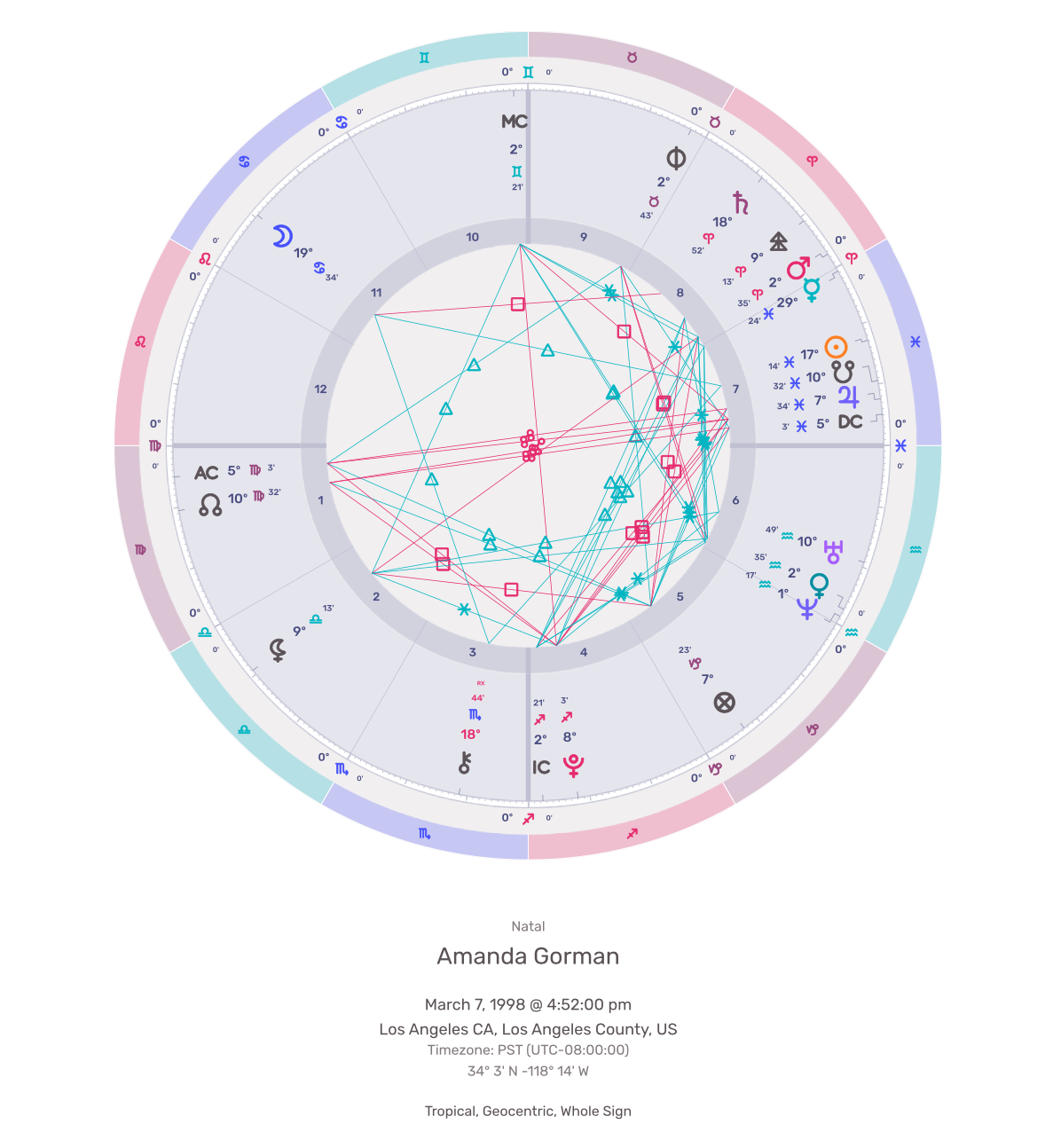
The Natal Chart of Amanda Gorman, AA Rating.
According to public records, Gorman was born on March 7, 1998 at 4:52 PM in Los Angeles, CA, with the Sun in Pisces and Virgo ascending on the eastern horizon. She and her twin sister, and brother were raised by a single mother, who was an English teacher. Her rise to national recognition didn’t come without obstacles. Early in life, Gorman developed a speech impediment and auditory processing disorder, making it difficult for her to pronounce certain letters in the alphabet along with sensitivity to sound. She turned to poetry and writing as therapeutic tools, and used songs to practice articulation and flow. In interviews, Goraman has often said that she always considered these challenges to be her gifts. Sometimes a perceived limitation can become a strength, leading one toward fulfilling their calling.
In April 2017, at age 19, Amanda Gorman was named the inaugural National Youth Poet Laureate. At that time, she would have been in an Eighth House profection year, putting a spotlight on the themes related to the resources of others, debts, and inheritances. Ancient astrologers referred to the Eighth House as “The Idle Place” because it does not have a traditional aspect to the Acendant and First House. Gorman has Aries in her Eighth House, where her Mars is in domicile, meaning it is the Time-Lord for age 19, as well as each Eighth House profection year that follows. This particular placement also means that the planet Mars, in its diurnal sign of domicile, has the ability to function at its full capacity. This placement signifies a keen passion to look deeply into the subconscious. It can signify one who can harness their courage to pierce through the veil to reveal the deepest fears and desires that we encounter as human beings. With Mars in the Aries in the Eighth House, there is a capacity to bravely go first, and face what is difficult.
When Gorman delivered her poem “The Hill We Climb” at the presidential inauguration in January 2021, she was 22 years old. During this pivotal moment in life, she was in an Eleventh House profection year. The Eleventh House in astrology, referred to as “The House of Good Spirit,” is associated with community, friendship, and hope. Recall that this House is on an axis and in opposition to the Fifth House, referred to as “The House of Good Fortune,” which signifies creativity, pleasure, and children.
In the Eleventh House, Amanda Gorman has her Moon, which is in the sign of its domicile in Cancer, the sign of the Crab. Thus, the Time-Lord for age 22, and each subsequent Eleventh House profection year is ruled by the Moon. Her Fifth House is in the sign of Capricorn, which is ruled by the planet Saturn. In her chart, Saturn is located in the Eighth House. This presents an interesting dynamic between the Eighth House and Eleventh House, which makes a sign-based square aspect. Squares are of the nature of Mars, meaning they tend to generate tension or friction that serves as a catalyst for action and achievement. Because Gorman has her Fifth House in the sign of Capricorn, symbolized by the Sea Goat, it signifies that she is steadfast in her creative pursuits.
There is an important correlation to note here, at two very important, and life-changing moments in time. At ages 19 and 22, Amanda Gorman had both Time-Lord planets for each of those years in their sign of domicile: The Moon in Cancer, and Mars in Aries, respectively. When planets are in their domicile signs, they are said to have access to all of their resources, and depending on their relationship to other points and planets, are able to operate, or express themselves at full capacity. This example pinpoints how planetary Time-Lords can ripen to become predominate forces in the trajectory of a person’s life.
Amanda Gorman has continued to cultivate her poetic voice, building upon the solid foundation that was established in early life. Through persistence and passion she has, in a way, climbed a hill, rising to international acclaim and inspiring poets of all ages. Her chart helps to elucidate the practical application of Annual Profections, unearthing the essence of what is meant by “divine timing.” The seeds we sow in the private, subterranean realm below the horizon, will eventually emerge forth through us to join the collective.
Work with Divine Timing in Your Natal Chart
When we take the time to pause and reflect on specific periods of time in our lives, there is often a breadth of nuance and wisdom to be uncovered. In looking at two significant years in a young poets life, through the lens of Annual Profections, we can begin to understand its utility. Time-Lord techniques can help to ground an astrology reading in the present moment, highlighting the inherent animacy of a chart not as one-dimensional image, but a living, breathing tapestry.
If you’re ready to unlock core patterns, tune into key themes, and prepare for aligned opportunities, I invite you into a deeper conversation about how Annual Profections can help. Book your complimentary consultation to dive in.
___
References
Avelar, Helena and Ribeiro, Luis. (2010). On the Heavenly Spheres: A Treatise on Traditional Astrology. American Federation of Astrologers, Inc.
Brennan, Chris. (2018, April 26). Annual Profections: A Timing Technique from Ancient Astrology. YouTube. Retrieved June 19, 2026, from https://youtu.be/UBwfIMnBKZk?si=d_lZUx7t2-RzpXWS.
Rudhyar, Dane. (2010). The Twelve Astrological Houses: The Way of Creative Accomplishment. Khaldea.com.
Vales, Vettius. (2022). The Anthology. Amor Fati Publications.
Wikipedia contributors. (2026, May 6). Amanda Gorman. In Wikipedia, The Free Encyclopedia. Retrieved, June 19, 2026, from https://en.wikipedia.org/w/index.php?title=Amanda_Gorman&oldid=1352839687